Bylaws & Governing Documents
Click here to view.
Understanding Our Bylaws Online Class
Participants will learn the important differences between association documents, how to read them and how Florida Statutes affect them.
Click here to view.
Out with the Old and In with the New: Upgrading Your Community Association Documents Online Class
Operating a community association with outdated governing documents is risky business. Your documents should be updated to stay current with the law and the operation as it has evolved under unit owner control, not under developer control. Also, there is a benefit to clarity in the documents, particularly as regards the allocation of maintenance and repair responsibilities. This webinar provides the tools you need to confidently bring your documents up-to-date.
Click here to view.
Amending and Restating Documents Webinar
Click here to view.
https://blog.shipplawoffice.com/florida-condominium-governing-documents/
What Are Florida Condominium Governing Documents
As a West Palm Beach Condominium Attorney, I am always asked what are Florida Condominium Governing Documents?
Understanding your Association's Governing Documents is very important. It is also very important to know the hierarchy of your Association's Documents and what controls if there is a conflict between the Association's document and law.
What Are Florida Condominium Declarations?
A Florida declaration is the document that establishes a community association in Florida. This document is often referred to as the "constitution" or the "bible" of the community association. The declaration is recorded in the public records of the county in which the association is situated. If there is a conflict between the association's governing documents, then the terms of the declaration take precedence over, or "trump", any provision in any of the other governing documents.
What Are Florida Condominium Articles Of Incorporation?
The Articles of Incorporation identify the association's official name and address, describe the purpose for the association, and identify the number of directors and officers. If there is a conflict between the governing documents, then the articles of incorporation trump any provision in the bylaws or rules or regulations, but are trumped by the declaration.
What Are Florida Condominium Bylaws?
The bylaws typically contain more detailed information regarding the calling of meetings, nomination and election of directors, quorum requirements, and the powers and duties of the directors and officers. If there is a conflict between the governing documents, then the bylaws trump provisions in the rules or regulations, but are trumped by the declaration and articles of incorporation.
What Are Florida Condominium Rules And Regulations?
Most declarations give the board of directors the power to adopt certain rules and regulations to help govern the community. The rules and regulations often set forth obligations for using association facilities, and clarify restrictions set forth elsewhere in the governing documents. For example, rules and regulations may include: architectural control requirements, business use restrictions, leasing restrictions, noise and nuisance rules, parking restrictions, pet restrictions, and sign restrictions, among others. The most important point to remember here is that the rules and regulations must be reasonable, and since they are trumped by all of the other governing documents discussed above, they must not conflict with any provisions found in the governing documents.
Remember, when the governing documents conflict with Florida law, Florida law prevails, unless Florida law says otherwise. For condominiums, Florida Statute 718 is the law.
The Law Office of Ryan S. Shipp, PLLC and its experienced and knowledgeable team of West Palm Beach Condominium Attorneys and West Palm Beach HOA Attorneys are here to help. Let us assist with your Associations' General Legal Matters and Collections for Delinquent Assessments. Call us today @ 561.699.0399. We are located in Lantana, we serve West Palm Beach and South Florida!
https://www.jimersonfirm.com/blog/resources/faqs/condominium-law/
Association Governing Documents
This area contains Declaration of Condominium and Amendments for Century Village associations that were filed with the Clerk of the Circuit Court & Comptroller, Palm Beach County, Florida.
Disclaimer---Our club makes every effort to publish the most current and accurate information; however, we make no warranty or guaranty concerning the accuracy of the information retrieved from the PBC Official Records Database, and in accordance thereto, any information retrieved is not to be used as support in any official matter.
Declaration of Condominium
The declaration of condominium is the document or the set of documents that actually creates the condominium. Condominiums are created when the declaration of condominium is recorded in the public records of the county where the land is located, executed and acknowledged with the requirements for a deed. All units described in the declaration as being located in or on the land then being submitted to condominium ownership shall come into existence. Section 718.104, Florida Statutes describes all that is required to be included in the declaration. The declaration includes within its definition any amendments which may be made to it, and all exhibits which are attached and incorporated by reference. The typical exhibits to the declaration include the document or documents creating the association, a copy of the bylaws, a survey of the land, a graphic description of the land, and a plot as demonstrated by building plans, floor plans, maps, surveys, or sketches.
Articles of Incorporation
The articles of incorporation is the original document creating the association. The articles of incorporation may establish either a for-profit or not-for-profit-corporation to establish the condominium. Under most circumstances, the articles of incorporation establish a "corporation not-for-profit" under Chapter 617 of the Florida Statutes to govern the condominium.
Bylaws
The bylaws of the association govern the operation of the association, which may include methods of adopting and amending administrative rules and regulations governing the use of common elements, the restrictions and regulations regarding the use, maintenance, and the appearance of the units and their use of the common elements, provisions for giving electronic notice for board, committee, annual, and special meetings. The bylaws may also contain other provisions that are not inconsistent with the Florida Condominium Act or with the declaration, as may be desired.
Rules & Regulations
The condominium association has the authority to pass reasonable rules and regulations that relate to the elements of the condominium that affect the owners as a whole, such as whether pets are allowed, the use of parking spaces and the weight of vehicles. Rules and regulations are created to promote the health, happiness, and peace of mind of the majority of the unit owners since they are living in close proximity and using common facilities. However, these rules may not be arbitrary or capricious. Additionally, compared to the restrictions within the declaration of the condominium, the rules and regulations do not have a strong presumption of validity and enforceability.
Understanding the Distinction between the Different Association Governing Documents
A recent decision from Florida's Second District Court of Appeal highlights the importance of understanding the distinction between the different documents that govern the Association, as well as when and how each needs to be amended. Many people use the term "bylaws" as a catch-all term to describe the entire set of documents, but each document serves a different purpose, even if there is some overlap in provisions from time to time.
The case is Joy v. Oaks Club Corporation, - So.3d -- 2022, WL 2541701 (Fla. 2d DCA July 8, 2022), wherein the Joys challenged their Club's decision to use its bylaw amendment procedure, rather than amending the Declaration, to redefine the membership requirement. Since the Declaration was recorded, it provided that an existing property owner could purchase another property within the community without having to purchase an additional club membership. The Declaration only required that all property owners be members of the Club. The Club amended its Bylaws, and not the Declaration, to provide that an existing property owner who purchases an additional property must now also purchase an additional club membership with each new property acquired in the community. An amendment to the Bylaws required approval by a simple majority of the owners, while an amendment to the Declaration required the approval of a super-majority of the owners, specifically by not less than 75% of the owners. The Joys sued contending that the amendments to the Bylaws were void and only an amendment to the Declaration could change the mandatory club membership requirement. The Court agreed. It explained, in part, that the obligation of an owner to purchase a single club membership was based for thirty years on the Declaration, and therefore the Court was thus hard-pressed to find that the Club could redefine this requirement through a bylaw amendment.
This case serves as a reminder to understand the hierarchy of the Association's governing documents. At the top of this hierarchy is the Association's Declaration. Florida case law often describes the Declaration as the Association's "constitution" as it carries the most legal weight of the Association's documents. This means that provisions of the Articles of Incorporation, the Bylaws, or the Rules and Regulations cannot contravene an express provision of the Declaration. The Articles of Incorporation create the corporation or the corporate entity responsible for the management and operation of the condominium – in other words, the Association. The Bylaws contain the operating procedures of the Association. This is the document that generally contains meeting procedures, notice requirements, and other operational matters. Finally, the Rules and Regulations, which are essentially the "do's and don'ts" of the community that govern day-to-day functions of the community. For example, pool rules or gym rules will be found therein.
Moreover, not only can the Articles, the Bylaws, and the Rules and Regulations not contravene an express provision of the Declaration, but Florida case law has also established that these documents cannot contravene a right reasonably inferable from the Declaration. Determining whether an amendment contravenes a right reasonably inferable from the Declaration is tricky and should be determined with the assistance of association counsel.
For example, returning to the case described above, the Court discussed that the Club Declaration required only that all property owners be members, but once membership was obtained, the Declaration contained no limitations on the nature or the scope of the property that may owned. Thus, the Court reasoned that the right to own multiple properties while only being required to purchase one club membership was a right reasonably inferable from the Declaration. This meant that the Bylaw amendment requiring the purchase of additional club memberships for each additional property purchase in the community contravened this right inferable from the Declaration.
Lastly, despite the Declaration's ultimate place at the top of the document hierarchy, it is important to note that if the Declaration is in conflict with the law, the law prevails in most instances. There are several statutory provisions that expressly defer to the governing documents. Again, working with experienced association counsel will ensure that the documents are properly in line with the law so that such a conflict does not find itself in the Association's documents.
In addition to understanding the function of each document and their hierarchy in relation to one another, it is important to determine whether each governing document is subject to its own amendatory procedure, which is the case in many communities. Generally, the Declaration may require the highest level of owner vote, such as in the Joy case wherein the Declaration required a super-majority approval and the Bylaws required a simple majority approval. This means that the Club's decision to amend the Bylaws, even if it did receive a membership approval for the same, was not enough. Some communities have association counsel draft amendments that can simplify the amendatory procedure. For example, the Declaration, Articles of Incorporation, and the By-Laws can be amended to have matching amendatory thresholds, which can be easier to remember and implement. In some cases, the vote is based on the total number of members, and in other cases, the required vote to amend is based on the number of members who actually vote at a meeting where a quorum is established. The latter is generally recommended to combat voter apathy and can be changed with the assistance of association counsel. Lastly, in most communities, the rules and regulations are typically adopted and amended by a vote of the Board alone, assuming the other documents give the Board adequate rulemaking authority. The Board's rulemaking authority is found in the other three documents, and the Board should verify with counsel when adopting new rules to determine if this is within the scope of their authority.
A higher threshold for amending the Declaration, or a requisite membership approval for amending the Declaration, the Articles, or the Bylaws rather than a Board-made rule, should not deter the Board from properly amending the correct document. Improperly passing a rule or amending a document in the procedurally incorrect fashion can lead the Association to expensive issues and legal liabilities. By working closely with experienced association counsel when amending any of the Association's governing documents, the Association can ensure that the provisions of its documents are legally enforceable, complimentary to one another, and in the best interest of the community.
Karyan San Martano | Attorney at Law, Becker | Ft. Lauderdale
Hierarchy Within Florida Community Associations
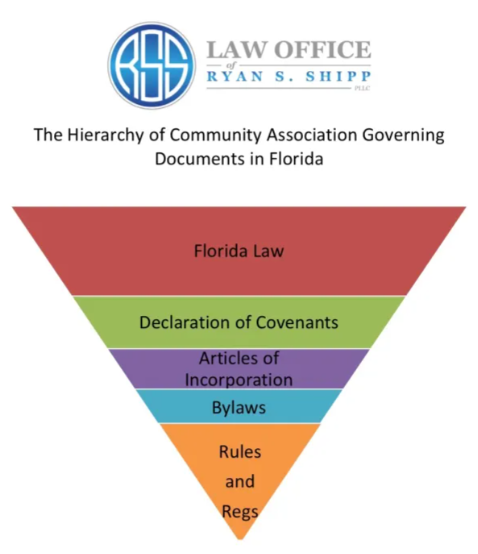
In Florida, community associations are governed by a set of rules and regulations that determine how the association operates. These rules create a hierarchy of authority, which helps to clarify what takes precedence when there are conflicts or disagreements.
At the top of this hierarchy are the Florida Statutes. These statutes provide the framework for community associations in Florida and cover everything from the formation and operation of the association to the rights and obligations of unit owners.
The next document in the hierarchy is the Declaration of Covenants, Conditions, and Restrictions (CC&R). This document is the primary governing document for the community association and outlines the rights and responsibilities of the association, unit owners, and board of directors. It also includes restrictions on the use of the property and common areas, as well as provisions for the assessment and collection of fees.
The Articles of Incorporation come next in the hierarchy. These legal documents establish the community association as a corporation under Florida law and provide information about the purpose of the association, the number of directors, and the procedures for electing directors.
After that, there are the bylaws, which are the rules and regulations that govern the internal affairs of the community association. They cover things like how meetings are held, how officers are elected, and other important business-related matters.
Finally, there are the rules and regulations, which are created by the board of directors to supplement the CC&R and the bylaws. These rules cover issues like the use of common areas, parking, and pets.
It's important to note that if there is a conflict between any of these documents, the higher document takes precedence. For example, if there is a conflict between a rule adopted by the board of directors and the CC&R, the CC&R takes precedence.
Community Association Pyramid
As such, we have created the below pyramid which illustrates the hierarchy between governing documents in Florida Community Associations. Always remember that whenever any of the Community Association documents conflict with Florida Law, unless the law states otherwise, Florida Law always prevails.
Law Office of Ryan S. Shipp, PLLC and its team of Florida Community Association Attorneys are here to assist with all of your Florida Condominium and HOA needs. Call us today @ 561.699.0399 to see how we can assist. We are located in Lantana, Florida. We serve all 67 Counties representing homeowners against their Community Association(s) throughout the great State of Florida.
https://www.daniafernandez.com/2021/05/04/enforcing-condo-association-bylaws-what-you-need-to-know/
Enforcing Condo Association Bylaws - What You Need to Know
by Dania S. Fernandez, Esq. | May 4, 2021
Thinking about buying a condo and living the good life in the sunshine state? Chances are high that you'll be joining a condo association. Florida continues to lead the country in the most HOAs and condo associations in the country. If you're new to Florida or new to the condo association life there are a few things you needs to know, specifically when it comes to the bylaws.
In this blog we'll give you an overview of what you need to know about condo association bylaws, their legal basis and the enforcement of these rules and regulations.
Read the fine print
Buying a home is a major process, to say the least. You have so much paperwork, contracts and legal mumbo jumbo to sort through, on top of all the other stress and negotiations that it can be easy just to just sign on the line and move on. But you MUST spend time getting to know your condo association's byways, also known as covenants, conditions and restrictions (CC&Rs), before closing on your condo.
The bylaws could impact you in many ways. There could be pet regulations, maintenance standards, rental regulations, architectural guidelines, noise requirements, and on and on that you may or may not agree with but you will have to follow. DO NOT gloss over the bylaws. Read them thoroughly and understand the impact that these rules may have on your lifestyle and your condo investment. If you are unsure about the language or unclear about any of the CC&Rs make sure you address your questions to the condo board. We also offer a number of free resources to help you understand community law in Florida.
Follow the rules
It cannot be overstressed that you are obligated to follow the condo association guidelines. Once you purchase that condo you will be required to join the condo association and will be legally bound to follow all rules and regulations in the CC&Rs. If your condo building has an association you are required to join. There is no opting out of the association.
The Florida Homeowners' Association Act and the Florida Condominium Act form the legal basis that gives condo associations the ability to create rules and enforce them. As long as bylaws fall within the legal realms of these acts they are enforceable by state law.
How bylaws are enforced
While we do want to reiterate that those CC&Rs are legally binding, this is not meant to scare you out of joining an association. Many people love being part of an association with the community it creates and the amenities they get to enjoy. As long as you can abide by all the rules and regulations, you could be overjoyed with your association. But what happens when you break the rules?
Well, to put it succinctly, there can be consequences to not abiding by CC&Rs. It generally starts with a fee or fine. Again, if you are imposed with a fine, you are obligated by law to pay it. Failure to pay fines or association dues can lead to a lien placed on your home and if the situation is not rectified it can actually lead to foreclosure. That's right, a condo association can have the legal right to foreclose on your home.
Foreclosure is an extreme scenario and it's the absolute last step in dispute settlement. Legal disputes within the community must go through a process resolution, which involves internal dispute resolution (IDR), then mediation, then arbitration. Only if these steps have not worked does the matter finally end with litigation.
To wrap up, the rules and regulations of condo associations are meant to foster community, keep the value of your home and ensure that all communal spaces and amenities are taken care of.
Most people find the CC&Rs to be reasonable and oftentimes preferable to non-association living. But if the rules conflict with your lifestyle or the plans that you have for your condo, you'll want to make sure you know before you make a legal agreement. Because (have we said it enough?) you are legally bound to all CC&Rs once you join the association.
We know all this talk of legal obligation can sound intimidating but the laws in place are meant to protect both the association and the individual homeowners. As long as you are walking into your association well-versed in the CC&Rs and with eyes open you should find that the condo association life is a wonderful thing!
https://www.floridacondoattorneys.com/condo-hoa-boards-change-restrictions-owners-vote/
Can Condo and HOA Boards Change Use Restrictions Without Owners' Vote?
Many of us in Florida live in Condominiums and Homes governed by Associations. These Associations are typically run by Board Members that we elect to run our development. What happens when the Board tells us that we can't have dogs over a certain weight, that our teenagers can't use the common Gym unless they have a licensed and insured personal trainer or that our little ones cannot play catch on a field of grass in front of the clubhouse?
The Sun Sentinel recently reported that a Coconut Creek homeowners association was trying to ban children from playing in a field often used for impromptu soccer and football games. (Can HOAs keep kids from play? – Sun Sentinel, page 1 of the Money Section, 1/7/2012 ). Daniel Vasquez reported that the Association claims that they are protecting the Community by trying to ban children from playing in a field that is adjacent to the common area pool and playground. He also reported that the Association is temporarily backing off of this ban until it's February elections. Apparently this is not an isolated occurrence. Another Association has actually proposed a rule banning kids from playing outside unless accompanied by an adult. In this Sun Sentinel Article the HOA in Edgewater called Persimmon Place actually intends to impose a fine of $100 for any such violation. In addition, they want to ban the game of tag, skateboarding, Big Wheels, loud or obnoxious toys. The real question, in these cases, is whether or not these issues are a matter within the Board's rule making authority or whether they should be voted on by the owners.
This issue was decided in Beachwood Villas Condominium v. Poor, 448 So.2d 1143 (Fla. 4th DCA 1984). Now when a court is called upon to assess the validity of Board enacted Rules it must first "determine whether the Board acted within its scope of authority and second, whether the rule reflects reasoned or arbitrary and capricious decision making." The court went on to note that in order to determine whether the topic of a rule is a legitimate subject for board rulemaking, it must not contravene either an express provision of the declaration or a right reasonably inferred therefrom. Although a board may propose a rule that changes or modifies the declaration the board will still need to have the owners vote to approve the change and follow the procedures for amending the declaration. The board may not act alone in this regard.
I have seen many cases where boards have enforced rules that are outside the scope of their rule making authority. In many instances this practice has gone on for years without any challenge from the owners. People have been forced to get rid of pets, kids have been banned from playing and these Associations have been allowed to be run like dictatorships. All too often we are told of various Rules that we must comply with at our Florida Community Associations. Just because our Board Members voted and enacted these Rules does not mean that we should blindly follow them? Part of the problem is that many Board Members serving Condo Associations and Homeowner Associations are unaware of what proposals need to be voted on by the Owners and what matters the Board can enact on it's own. The first place to look is the Association's Governing Documents. These typically include the Declaration, By-Laws, Articles of Incorporation and Rules and Regulations. The Declaration of the Association is like the Constitution for that particular development and takes precedence over the By-Laws, Articles of Incorporation and Rules and Regulations.
In Florida, the law is clear that Rules (made by the Board) cannot contradict the Association's Declaration or a right reasonably inferred therefrom. While the Declaration is typically drafted by the representatives for the Developer, Florida Law does allow it to be changed or amended from time to time. Section 718.110 of the Florida Statutes (720.306 for Homeowners Associations) states that the Declaration may typically be amended if it is approved by a two thirds vote of the owners. Moreover, for it to be effective it must be recorded in the public records of the county where the declaration is recorded. While Associations are free to amend the percentage voting requirements, this does not change the basic principal that the owners must vote to approve or reject an amendment to the Declaration.
If your Association has sent you a Violation letter, or you are looking to rent or buy in a Florida Condominium Association or Homeowner Association you should know what the Use Restrictions are and whether or not they are valid. As a Florida Law Firm with over 20 years of Trial experience we can help you fight your Association or simply review and analyze the Association's Governing Documents for you before you move in to see if it is a place you really want to live in.
The Law Offices of Herb M. Milgrim, P.A. is a Florida Law Firm that represents Condo Owners, Homeowners and Cooperative Owners that have disputes or are contemplating Litigation or a Lawsuit against their Association. We provide prospective clients with a *Free Case Evaluation. You can call us and tell us about your case to see if we can help you. Once we have been retained we review all of the relevant documents and governing Florida Laws and advise our clients on the best course of action. Call us now (954) 966-3909!
* Free Case Evaluation is by telephone and does not include legal advice. Office consults with legal advice are available on a flat fee basis.
March 16, 2021 | By: Christopher L. Pope, Esq., Board Certified by the Florida Bar in both Construction Law and Condominium and Planned Development Law
Five Common Problems With Condominium Documents That Leave Condominium Associations and Their Memers Exposed
The governing documents of condominium associations, which include the Declaration of Condominium, the Articles of Incorporation, the Bylaws, and any Rules and Regulations, are often outdated, inconsistent with Florida Law, or do not meet modern standards for a condominium.
The condominium documents inevitably become outdated because the Florida Statutes are frequently amended, Court Cases are decided, and the social norms of society evolve over time. Even 15 years ago, the document drafters could not have foreseen the challenges of room sharing services such as VRBO, the demand for electric charging stations for automobiles, electronic meeting notices and voting, or, more recently, emergency powers for a pandemic like COVID-19.
Furthermore, the original documents are often drafted on behalf of a developer and are less restrictive, because the developer is trying to cast a wide net to sell the units as quickly as possible without objection. If a condominium is still operating under original developer documents well after the time of turnover or just old documents, the condominium association would be wise to have them reviewed to determine if they need to be amended and restated to bring them in line with the expectations demanded for a present-day condominium.
Below is a list of only five of the many common problems with outdated governing documents:
1. No right to approve tenants or occupants; or charge transfer fees
A condominium association has no right to screen, approve, or disapprove tenants or occupants unless such rights are stated in the governing documents. Many associations are unaware of this until it is too late and there is little they can do to quickly remove a problem tenant or prevent an unapproved tenant from moving in. With fewer places to live for people that would not pass a background check (such as violent criminals and sexual predators), word that a condominium has no approval restrictions can quickly spread, and the condominium can become a magnet for people that would not otherwise pass a background check, which drives down the value of the units.
Another problem is that it is not uncommon for condominium associations and their managers to be unwittingly screening tenants and charging fees without any authorization. Condominium associations should be aware that any attempt to enforce such rights without authorization in the governing documents may subject the association to legal liability to the owner and tenant or occupant.
Furthermore, pursuant to Section 718.112(2)(i), Florida Statutes, a condominium association can only charge a transfer fee in connection with the sale, mortgage, lease, sublease, or other transfers if it is required to approve such transfer and the fee is provided for in the Declaration, Articles, or Bylaws. The amount of the fee may not exceed $100 per applicant, regardless of the cost the association is obligated to pay its management company. Note that spouses and dependent children are considered as one applicant.
The solution to these problems is likely to amend the Declaration to require the association to approve unit transfers and leases, and charge the maximum transfer fee. It can be easy to garner the necessary membership support to amend the Declaration when the risks for doing so are explained.
2. No entitlement to late fees or maximum interest for delinquent assessments
No owner wants to pay late fees and interest when they miss a payment, but late fees and interest help make the condominium association whole for the expenses it incurs when a unit owner does not pay on time and becomes delinquent. However, the association is only entitled to collect an administrative late fee if it is provided for in the Declaration or the Bylaws, and, if so, can charge up to the greater of $25 or 5% of each delinquent assessment. If your condominium association's Declaration or Bylaws do not provide for a late fee or has a late fee lower than what is allowed by the statute, they should be amended to reflect Florida law.
Similarly, delinquent assessments bear interest at the rate provided in the Declaration. If no rate is provided in the Declaration, then interest accrues at the rate of 18% per year. If your Declaration specifies an interest rate lower than 18% percent, the provision needs to amended or deleted so that the association can collect the maximum interest.
3. No specific maintenance schedule for unit owners
There are several items that, if not timely maintained or replaced, will fail and cause water damage to the condominium's common elements and other owners' units. If the unit where the failure occurs is vacant, the damage is exacerbated.
Examples of common items that are often ignored include water heaters, washing machine water supply hoses, and the condensation lines for air conditioners. A water heater has an approximate useful life of 7 years and the supply hose of a washing machine is approximately 5 years, so the governing documents should specifically state how often these items should be replaced. The Declaration should require the condensation line to be checked and cleared every six months by the unit owner if it is not the association's responsibility. Moreover, unit owners should be required by the Declaration to turn off the water to their unit whenever it will be vacant for 48 hours or more.
The three benefits of having a specific maintenance schedule in the Declaration are: 1) it puts the owners on notice of the maintenance that needs to be performed, 2) the association can take preventative action, such as sending reminders and requiring that the maintenance or replacement be performed, and 3) it is much easier for the association to hold an irresponsible unit owner accountable for any out of pocket costs that otherwise have to be paid by innocent parties, such as the association and other affected unit owners.
With respect to out of pocket costs, according to Section 718.111(11)(j)(1), Florida Statutes: "A unit owner is responsible for the costs of repair or replacement of any portion of the condominium property not paid by insurance proceeds if such damage is caused by intentional conduct, negligence, or failure to comply with the terms of the declaration or the rules of the association by a unit owner, the members of his or her family, unit occupants, tenants, guests, or invitees, without compromise of the subrogation rights of the insurer." However, it is difficult to use this statute unless there is a violation of the terms of the Declaration or Rules, because it is not easy to prove negligence or intentional conduct for most water leaks.
By establishing a specific maintenance schedule in the Declaration, the association will have an easier time applying the statute because it will only need to show a failure to comply with the Declaration, rather than negligence or intentional conduct. For example, if the Declaration requires water heaters to be replaced every 7 years, it is easier to prove that an owner failed to timely replace an 8 year old water heater than it would otherwise be to prove the unit owner was negligent. In fact, absent specific and objective maintenance timelines, a derelict unit owner is unlikely to pay for the damage he or she caused, and the other owners will end up paying out of pocket, whether for damage to their unit or their share of a common expense of the association.
On a final note, the responsibility for drying out the unit and any resulting mold is not often addressed in the condominium's governing documents. The association can limit its exposure by specifically addressing these items in the Declaration.
4. Outdated insurance provisions
Florida law regarding the insurance requirements has evolved and been revised many times over the years. As such, we often see older governing documents with maintenance and insurance provisions that are not aligned with current law. In addition, the insurance policies could also be in conflict with the Declaration, the law, or both, and when there is conflict and uncertainty the likelihood of litigation increases significantly. As a result, the Declaration's insurance provisions must be reviewed and updated regularly so that the owners and the condominium association have a clear understanding of their obligations and rights, to ensure that neither inadvertently relies on an outdated provision, exposing them to liability. This is an area the association's Board of Directors must get correct, because the Board has a fiduciary obligation to the unit owners to protect them by reducing the likelihood of protracted litigation over insurance coverage or maintenance obligations.
5. High amendment voting threshold
Many older condominium documents require an unreasonably high number of votes to make general amendments to the documents, some as high as 80% of all unit owners. When a voting percentage is based on all unit owners, by default an automatic "NO" vote is cast by owners that do not participate or that do not care about the condominium and its affairs. If a condominium cannot amend its documents with a reasonable number of votes of the membership, it will be plagued with the issues discussed above, causing apathy and hopelessness toward improving the condominium. The resale value of the units inevitably falls and the market may not make it easy for the association to collect the assessments it needs to even maintain the status quo.
The condominium can change its trajectory by passing an amendment to change the voting percentage to only those unit owners present at the meeting, either in person or by proxy, and voting. Doing so will give those owners who participate in the meetings of the association a voice and untether the future of the condominium from those who are disinterested or indifferent. Passing the amendment to change the voting threshold may seem like a daunting task, but an experienced condominium attorney can offer successful strategies for getting it done.
A note to the reader: This article is intended to provide general information and is not intended to be a substitute for competent legal advice. Competent legal counsel should be consulted if you have questions regarding compliance with the law.
Questions regarding the content of this article may be emailed to Christopher Pope at christopherpope@paveselaw.com. To view past articles, please click "Publications" on our firm website. Mr. Pope is Florida Bar Board Certified in both Construction Law and Condominium and Planned Development Law. He is a partner and an experienced construction and real estate attorney with the Pavese Law Firm, 1833 Hendry Street, Fort Myers, FL 33901; Telephone: (239) 336-6208; Fax: (239) 332-2243.