Association Boards
As the Board of their respective Associations progress through the standing term, they need to make changes to the Officers or members of the Board for any number of reasons that may occur suddenly. Knowing the process to make these changes as well as the requirements of both the state and your Governing Documents ahead of time will allow Boards to continue with the business of the Association without interruption.
At the start of your term of Directors, your Association Documents may have language that allows “five to seven” members. When planning for the annual meeting, you must be aware of what your documents provide as the means to set this number to maintain a consistent number of Board members year after year. If your Board has consistently had five members, you would need to refer to the terms of your documents to see how you can change to seven if desired, which may be either a Board resolution or a vote of the membership.
During the term, should a member of the Board be removed for any reason; by resignation, unit sale, passing, or otherwise, the Board will often have the right, but not the obligation, to appoint a new volunteer to the vacant position of the Board. However, if the number of remaining Board members falls below three, those remaining members must appoint enough volunteers to meet a minimum requirement of three members to fill the officer positions of the Board per state statute.
Throughout the term of the Board, the minimum requirement will be three members. This is to fill the Officer Positions of President, Treasurer, and Secretary. Some Associations, to simplify finding enough volunteers for a new term of the Board, have worked with their Attorney to amend their documents to reduce the required number of Board members to three (3).
Although it is often a challenge to find volunteers to take on the responsibility of the Board, you must be cognizant of the requirements of your Association documents and the State Statutes and try and keep in mind those unit owners who may be willing to step up to finish the remainder of the term should the need arise.
Click here to view.
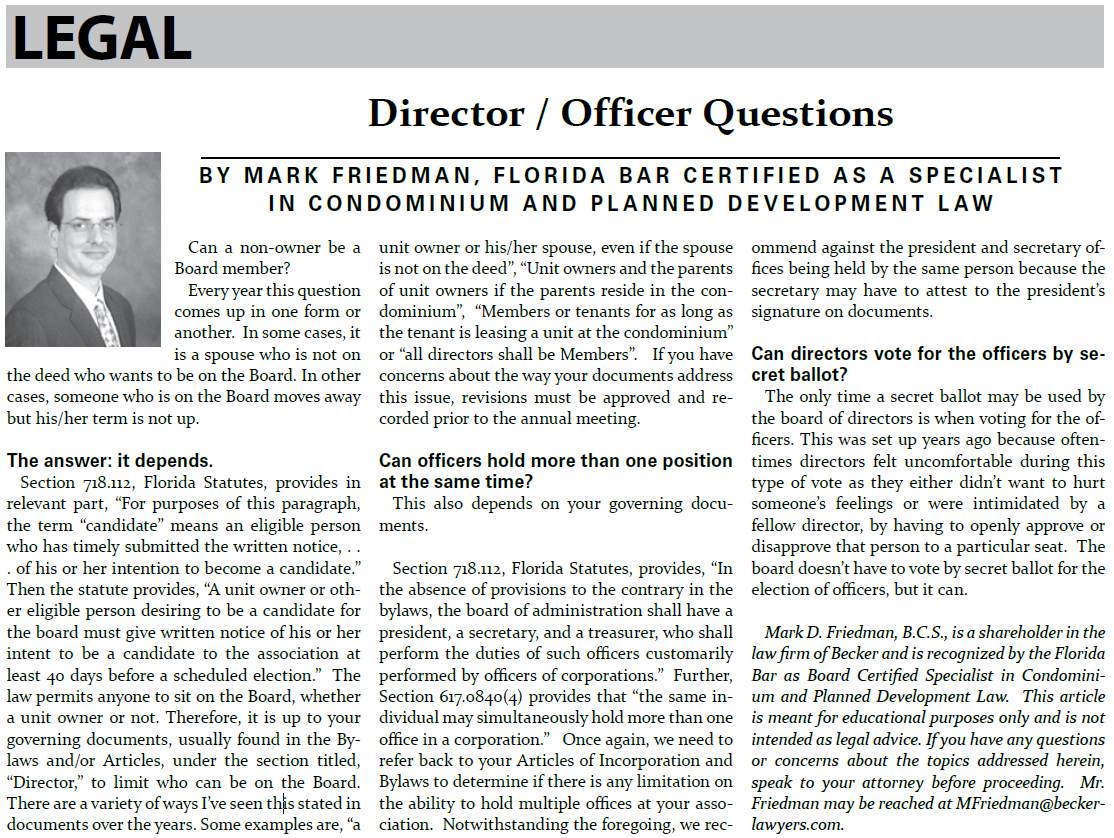
Can a non-owner be a Board member in a Condominium?
Every year this question comes up. In some cases, there is a person who is not listed on the deed, but would like to serve on the Board of Directors. Or when someone on the Board moves away before the term has expired.
The answer: It depends.
Section 718.112, Florida Statutes, provides in relevant part, “For purposes of this paragraph, the term “candidate” means an eligible person who has timely submitted the written notice, . . . of his or her intention to become a candidate.” Then the statute provides, “A unit owner or other eligible person desiring to be a candidate for the board must give written notice of his or her intent to be a candidate to the association at least 40 days before a scheduled election.” The law permits anyone to sit on the Board, whether a unit owner or not. Therefore, it is up to your governing documents, usually found in the Bylaws and/or Articles, under the section titled, “Director,” to limit who can be on the Board. There are a variety of ways we’ve seen this stated in documents over the years. Some examples are, “a unit owner or his/her spouse, even if the spouse is not on the deed”, “Unit owners and the parents of unit owners if the parents reside in the condominium”, “Members or tenants for as long as the tenant is leasing a unit at the condominium” or “all directors shall be Members”.
If you have concerns about the manner the documents address this issue, it is advisable to discuss these concerns with your community Association attorney. If you want to revise how this is handled for the upcoming annual meeting, membership approval is required. Amendments to your documents which must be recorded in the county’s official records.