Reserves
The page titled "Reserves" on the Board Synergy Club's website provides an overview of financial reserves within condominium associations. It defines "reserves" as funds set aside for deferred maintenance and capital expenditures, distinct from operating funds. These reserves are mandated by Florida Statute Section 718.112(2)(f) and must be included in the association's annual budget. The page also outlines the requirements for estimating operating budgets, emphasizing the necessity of disclosing all estimated common expenses and maintaining separate line items for each reserve account. Additionally, it discusses the procedures for waiving or reducing reserve funding, which require a majority vote from the unit owners. The importance of adequately funding reserves is highlighted to ensure the association can meet future obligations without imposing unexpected special assessments on unit owners.
From: https://www.jimersonfirm.com/blog/resources/faqs/condominium-law/
In addition to annual operating expenses, the proposed budget shall include reserve accounts for capital expenditures and deferred maintenance. These accounts shall include, but are not limited to, roof replacement, building painting, and pavement resurfacing, regardless of the amount of deferred maintenance expense or replacement cost, and for any other item for which the deferred maintenance expense or replacement cost exceeds $10,000.
Reserve funds and any interest accruing shall remain in the reserve account for authorized reserve expenditures, unless their use for other purposes is approved in advance by a vote of the majority of the voting interests present at a duly called meeting of the association.
Thank you for joining Campbell Property Management and Will Simons from Association Reserves for this "Fundamentals of Reserves" Webinar. This recording is from March 5, 2024 and was hosted on Zoom.
Learn how this impacts your community association.
To learn more, please visit: Campbellmgt.com
The funding of Association Reserves has become an increasingly important topic for Florida Condominiums. For the Associations in Century Village, the majority have opted to manage their own Reserve accounts and decide what the collection of Reserve Income for each year should be.
The Associations in the Village, that are three (3) and four (4) stories were mandated by the legislature to have a Structural Integrity Reserve Study (SIRS) performed to ensure that they collect the necessary funds for future projects. But there has been confusion as to what is expected for the Garden (2 stories) and Villas (single story) by the state for their Reserve Collections. Although not mandatory, it has always been encouraged to have a Reserve Study performed to ensure that your collections are accurate.
With that recommendation aside, there are key fundamentals to Reserves that must be understood by you and your Board Members so you may properly oversee your Reserve account. Because three- and four-story buildings were required to have a Reserve Study, the focus of this week’s article will be on the one- and two-story buildings in Century Village.
1. What projects must be funded at a minimum
The state has mandated that at a minimum, the projects that must be collected in the Reserves must be.
- Roofing
- Painting
- Paving
- Any Project over $10,000.00
- Concrete Restoration
- Laundry Equipment replacement
- Laundry/Storage/Meter door replacement
2. Component Vs Pooled Reserve Methods
The projects listed above, Roofing, Painting, and Paving, must be collected in the “Component” method of budgeting Reserve income. Some Associations have shown interest in having their Reserves collected in the “Pooled” method. This is due to the Pooled method potentially allowing Associations to simply collect enough funds to perform projects as their useful life expires as opposed to collecting the funds for all projects simultaneously.
This collection requires diligent oversight and an understanding of cost analysis, often requiring that the pooled reserve account be reviewed annually by a professional CPA. This is why the component method is considered the simplest and most easily approachable format for Condo Boards.
3. Fully, Partially, and Waiving Reserve funds
At a default, Reserve projects must be “Fully” funded, meaning that their total estimated replacement value will be collected during their estimated useful life. Many Associations, to keep their maintenance dues low, choose to “Partially” fund their Reserves.
When Reserves are funded fully, the Budget is simply an approval of the Board of Directors. If there is a desire to Partially fund Reserves, this alternate budget must be presented to the unit owners and approved by a majority vote of the total voting interest of the membership.
Some Associations even choose to “Waive” the collection of Reserve funds, this decision can have costly consequences to an Association. If your Association is considering offering an alternative budget to partially fund the Reserves, you should consult your Association attorney to ensure that this option is allowed by the legislation.
A final note on the consideration of alternative funding is that Roofing, Painting, and Paving can only be fully funded. So, if those three projects are the only items being collected in your Reserves, you will have no option but to Fully Fund.
4. What cannot be collected in Reserves
There are few limits on what can be collected in Reserves as the purpose of deferred maintenance is to collect funds for the common elements and expense of the Association. Should you have a desire to fund Landscape beautification, Insurance Deductible, Pool Furniture, etc., you are allowed to do so as these are all individual and specific projects.
What cannot be collected is unspecified projects. It is not unheard of for Associations to be collecting for “Contingency”, “Misc”, “Surplus”, in their Reserves. Under the legislation, these unspecified collections are not allowed, projects must have a specific purpose, replacement cost, and useful life.
If you are aware that your Association is collecting unspecified funds, you should consult with your Association Attorney or independent CPA to see what must be done to allocate these funds to be in line with the statutes.
For more information on Reserve funding, please consider reading the following articles:https://ssclawfirm.com/news-events/in-the-news/waiver-of-reserves-under-new-statutory-requirements
Boards Members are looking to correct the collection of their Association Reserves as the 2025 proposed budgets soon approach. Although it is not mandatory for the buildings two stories and lower, it has been regularly recommended that the Associations have a Reserve Study performed to ensure that they are collecting the correct reserve income.
For those who are choosing to try and take on the effort of constructing a Reserve Schedule themselves, there are several requirements and restrictions that you should be aware of. The state has mandated that Structural items be “Fully Funded” and the waiving or reduction of funding for these items may not be approved. Non-structural projects may still be waived or collect reduced funding by the approval of the majority of all unit owners.
The term “Fully Funded” has proven confusing to some asking what the implication of that requirement may be. Simply put, to fully fund a reserve item is to collect the total estimated replacement value over the course of the remaining useful life of the project.
What are Structural Items?
- -Roof
- -Structure/Concrete
- -Fire Protection
- -Plumbing
- -Electrical
- -Painting
- -Windows and Doors belonging to the Association
The state has also mandated that funds designated for structural items cannot be reallocated for other items, even between structural projects. As with the restrictions for reducing and waiving Reserve funds mentioned above, non-structural funds may be reallocated to other projects, including moving funds into structural projects, by the majority vote of all unit owners.
Some Board Members have asked if there is a minimum balance of the Reserve account that is required. The simple answer to that is no, as different Reserve items will be replaced at different times. A large expense such as the replacement of the roof can easily be the bulk of the balance of the Reserve account while the fund to replace the laundry room door would be insignificant by comparison. The remaining useful life of the various projects will fluctuate the balance of the Reserve account through the scheduled collection.
Finally, the state expects condominiums to collect these funds for the upkeep of the building. There is no alternative to maintaining a Reserve account, a line of credit from a banking institution is not considered a substitute. Improper Reserves will result in Special Assessments, Loans, and possibly mortgage lenders refusing to approve loans to buyers interested in purchasing in your Association.
For more information, please consider reading the following articles:
https://www.reserveadvisors.com/resources/blog/are-your-reserves-fully-funded/
If your association is insured by AssuredPartners, they provide your board with an option sheet. If your board does not return tghis sheet, they select option 2 on your behalf.
The option sheet, among other things, describes your hurricane insurance coverage. Specifically it lists your maximum hurricane payout and hurricane deductible.
The option sheet has 3 options. For 2024 they were 3%, 4%, and 5%. Below are the values for Northampton A:
| Option 1 (3% Hurricane Deductible) | Option 2 (4% Hurricane Deductible) | Option 3 (5% Hurricane Deductible) | |
| Property Limit | $2,010,740 | $2,010,740 | $2,010,740 |
| Hurricane Deductible | $60,322 | $80,430 | $100,537 |
| Insurance Premium | $33,464 | $31,614 | $29,844 |
To make repairs after a hurricane, the board must have funds in reserve to cover the cost up to the hurricane deductible. The insurance will not release any funds until the board provides the full deductible. This is important to understand. It may be difficult to raise this money if there is a shortfall in reserves as people may be unreachable for an extended time.
These are some of the categories you may want to include in your reserve funding:
- Roofing
- Concrete/Structural Systems
- Painting/Waterproofing
- Plumbing
- Electrical
- Other elements over $10,000
As the buildings that are three stories and higher in Century Village work towards completing their mandatory Milestone Inspections and Structural Integrity Reserve Study (SIRS), many of the other Associations have asked if a Reserve Study is something that they should also consider.
It's always encouraged that Associations look into having a Reserve Study performed ensure that they are collecting the appropriate reserve income for their annual budget. Some of the Associations have found themselves underfunded for expenses such as structural projects when it is time for those portions of the building to be replaced. This short fall of funds have resulted in Special Assessments being levied by Boards to collect the money necessary to complete these projects.
An Association can contract a professional Reserve Study company who will inspect the property and work with industry professionals to create a Reserve Schedule. This Reserve Schedule will list each project with its cost to replace, estimated useful life, remaining useful life, and balance collected to date. When calculated across these variables, an Association will be able to determine the annual Reserve income necessary to fund projects.
A Reserve Study and schedule will ensure that an Association is collecting enough funds to make these replacements and mitigate the need for a Special Assessment. Some Associations may find that they have been severely under funding their Reserves and the Reserve study results in a dramatic increase in the annual budget to collect for projects.
Despite this possibility, collecting the appropriate reserve income will ensure that Associations have the funds needed to make necessary repairs and replacements to the common elements of the Association.
Budgeting & Reserves Online Class
When creating a financial plan for your association there are many things to consider. Join Becker Shareholder Howard Perl as he discusses the steps it takes to create and maintain a successful budget and reserve plan.
Click here to view.
Reserve Fund Analysis & Budgeting Seminar
Learn about the Condominium Association Budgeting process and about the Reserve Data Visualization Platform that can help you achieve enduring financial stability for your association.
Click here to view the seminar.
The Negative Impact of Inaccurate Reserve Data - November 10, 2023
In the intricate world of condominium association management, the backbone of financial planning lies in the reserve study—a comprehensive evaluation determining anticipated repair and replacement costs over an extended period. This case study sheds light on the critical importance of accuracy in reserve studies and the consequences of overlooking the dynamic factor of inflation.
Click here to view the seminar.
The Importance of Condominium Reserve Studies: Ensuring a Secure Future for Your Property - September 11, 2023
Imagine owning a beautiful treehouse nestled within a condominium community, where the association takes care of the tree that supports your abode. Just like any homeowner, you would want to ensure the value and longevity of your property. In this blog post, we will explore the concept of reserve studies and how they play a crucial role in helping condominium associations maintain property value and plan for future expenses. As Louis Orloff, the managing director of Reserve Fund Advisers, aptly puts it, "You wouldn't want to wait for a roof leak to act – you'd want to prevent it altogether."
Click here to view the seminar.
What you need to know about budget planning and reserve funding
Click here to view the webinar.
Funding Reserves - ASL S4-E6
Click here to view the webinar.
What you need to know about budget planning and reserve funding
Click here to view the webinar.
Inflation and Reserves - November 15, 2022
Tanner Oldenburger, Vice President of Engineering at Reserve Advisors, discusses capital planning and the impact higher costs have on planning for the future. We’ll discuss a reserve study firm’s approach to addressing inflation in such unprecedented times and review best practices communities can implement to mitigate the burden of higher costs and addressing critical capital projects.
Click here to view the webinar.
The Negative Impact of Inaccurate Reserve Data - November 10, 2023
Click here to view.
Navigating Condo Budgeting Blog Post - November 6, 2023
Click here to view.
How Many Florida Condo Associations Are Financially Sound? by Christopher Carter, Real Estate Broker Associate, Licensed Community Association Manager, Mortgage Financing Advisor NMLS861361 - October 9, 2023
Click here to view.
COA Reserve Funds - What You Need to Know About Association Reserves by The Orlando Law Group - November 30, 2022
Click here to view.
Straight-Line or Pooled Condo Reserves - What's The Difference? by Christopher Carter, Real Estate Broker Associate, Licensed Community Association Manager, Mortgage Financing Advisor NMLS861361 - November 16, 2022
Click here to view.
Condo HOA reserves — Why all the controversy? by Deborah Goonan, Independent American Communities - April 7, 2022
Click here to view.
Can Condo Associations Invest Reserve Funds? by Dania S. Fernandez, Esq. - May 11, 2021
Click here to view.
Is Your Condo Following the Proper Reserve Protocol? by Siegfried Rivera (Law Firm) - February 9, 2016
Click here to view.
Looking at Condominium Reserve Accounts by Farr Law Firm
Click here to view.
For the purposes of this chapter the following definitions shall apply:
(1) "Accounting records" include all of the books and records identified in Section 718.111(12)(a) 11., Florida Statutes, and any other records that identify, measure, record, or communicate financial information whether the records are maintained electronically or otherwise, including, all payroll and personnel records of the association, all invoices for purchases made by the association, and all invoices for services provided to the association.
(2) "Capital expenditure" means any expenditure of funds for:
(a) The purchase of an asset whose useful life is greater than one year in length;
(b) The replacement of an asset whose useful life is greater than one year in length; or
(c) The addition to an asset that extends the useful life of the previously existing asset for a period greater than one year in length.
(3) "Deferred maintenance" means any maintenance or repair that:
(a) Will be performed less frequently than yearly; and
(b) Will result in maintaining the useful life of an asset.
(4) "Funds" means money and negotiable instruments including, for example, cash, checks, notes, and securities.
(5) "Reserves" means any funds, other than operating funds, that are restricted for deferred maintenance and capital expenditures, including the items required by Section 718.112(2)(f) 2., Florida Statutes, and any other funds restricted as to use by the condominium documents or the condominium association. Funds that are not restricted as to use by Section 718.112(2)(f), Florida Statutes, the condominium documents or by the association shall not be considered reserves within the meaning of this rule.
(6) "Turnover" means transfer of association control from developers to non-developer unit owners pursuant to Section 718.301, Florida Statutes.
(1) Required elements for estimated operating budgets. The budget for each association shall:
(a) State the estimated common expenses or expenditures on at least an annual basis;
(b) Disclose the beginning and ending dates of the period covered by the budget;
(c) Show the total assessment for each unit type according to proportion of ownership on a monthly basis, or for any other period for which assessments will be due;
(d) Include all estimated common expenses or expenditures of the association including the categories set forth in Section 718.504(21)(c), Florida Statutes. Reserves for capital expenditures and deferred maintenance required by Section 718.112(2)(f), Florida Statutes, must be included in the proposed annual budget and shall not be waived or reduced prior to the mailing to unit owners of a proposed annual budget. If the estimated common expense for any category set forth in the statute is not applicable, the category shall be listed followed by an indication that the expense is not applicable;
(e) Unless the association maintains a pooled account for reserves required by Section 718.112(2)(f) 2., Florida Statutes, the association shall include a schedule stating each reserve account for capital expenditures and deferred maintenance as a separate line item with the following minimum disclosures:
1. The total estimated useful life of the asset;
2. The estimated remaining useful life of the asset;
3. The estimated replacement cost or deferred maintenance expense of the asset;
4. The estimated fund balance as of the beginning of the period for which the budget will be in effect; and
5. The developer's total funding obligation, when all units are sold, for each converter reserve account established pursuant to Section 718.618, Florida Statutes, if applicable.
(f) If the association maintains a pooled account for reserves required by Section 718.112(2)(f) 2., Florida Statutes, the association shall include a separate schedule of any pooled reserves with the following minimum disclosures:
1. The total estimated useful life of each asset within the pooled analysis;
2. The estimated remaining useful life of each asset within the pooled analysis;
3. The estimated replacement cost or deferred maintenance expense of each asset within the pooled analysis; and
4. The estimated fund balance of the pooled reserve account as of the beginning of the period for which the budget will be in effect.
(g) Include a separate schedule of any other reserve funds to be restricted by the association as a separate line item with the following minimum disclosures:
1. The intended use of the restricted funds; and
2. The estimated fund balance of the item as of the beginning of the period for which the budget will be in effect.
(2) Unrestricted expense categories. Expense categories that are not restricted as to use shall be stated in the operating portion of the budget rather than the reserve portion of the budget.
(3) Record keeping requirements for budgets. The minutes of the association shall reflect the adoption of the budget and a copy of the proposed and adopted budgets shall be maintained as part of the financial records of the association.
(4) Multicondominium associations. Multicondominium associations shall comply with the following requirements:
(a) Provide a separate budget for each condominium operated by the association as well as for the association. Each such budget shall disclose:
1. Estimated expenses specific to a condominium such as the maintenance, deferred maintenance or replacement of the common elements of the condominium which shall be provided for in the budget of the specific condominium;
2. Estimated expenses of the association that are not specific to a condominium such as the maintenance, deferred maintenance or replacement of the property serving more than one condominium which shall be provided for in the association budget; and
3. Multicondominium associations created after June 30, 2000, or that have created separate ownership interests of the common surplus of the association for each unit as provided in Sections 718.104(4)(h) and 718.110(12), Florida Statutes, shall include each unit's share of the estimated expenses of the association, referred to in subsection (2) of this rule, which shall be shown on the individual condominium budgets. Multicondominium associations created prior to July 1, 2000, that have not created separate ownership interests of the common surplus of the association for each unit as provided in Sections 718.104(4)(h) and 718.110(12), Florida Statutes, shall include each condominium's share of the estimated expenses of the association, referred to in subsection (2) of this rule, which shall be shown on the individual condominium budgets.
4. The budgets of multicondominium associations created after June 30, 2000 or of multicondominium associations that have created separate ownership interests of the common surplus of the association for each unit as provided in Sections 718.104(4)(h) and 718.110(12), Florida Statutes, shall show the estimated revenues of each condominium and of the association.
(b) Associations that operate separate condominiums in a consolidated fashion pursuant to Section 718.111(6), Florida Statutes, may utilize a single consolidated budget.
(5) Limited common elements. If an association maintains limited common elements at the expense of only those unit owners entitled to use the limited common elements pursuant to Section 718.113(1), Florida Statutes, the budget shall include a separate schedule, or schedules, conforming to the requirements for budgets as stated in this rule, of all estimated expenses specific to each of the limited common elements, including any applicable reserves for deferred maintenance and capital expenditures. The schedule or schedules may group the maintenance expense of any limited common elements for which the declaration provides that the maintenance expense is to be shared by a group of unit owners.
(6) Phase condominium budgets. By operation of law, the annual budget of a phase condominium created pursuant to Section 718.403, Florida Statutes, shall automatically be adjusted to incorporate the change in proportionate ownership of the common elements by the purchasers and to incorporate any other changes related to the addition of phases in accordance with the declaration of condominium. The adjusted annual budget shall be effective on the date that the amendment to the declaration adding a phase to a phase condominium is recorded in the official records of the county in which the condominium is located. Notwithstanding the requirements of subsection (7) of this rule, the association shall not be required to follow the provisions of Section 718.112(2)(c), Florida Statutes, unless, as a result of the budget adjustment, the assessment per unit has changed.
(7) Budget assessment amendments. The association may amend a previously approved annual budget. In order to do so the board of administration shall follow the provisions of Section 718.112(2)(e), Florida Statutes. For example, the board shall mail a meeting notice and copies of the proposed amended annual budget to the unit owners not less than 14 days prior to the meeting at which the budget amendment will be considered.
(1) Reserves required by statute. Reserves required by Section 718.112(2)(f), Florida Statutes, for capital expenditures and deferred maintenance including roofing, painting, paving, and any other item for which the deferred maintenance expense or replacement cost exceeds $10,000 shall be included in the budget. For the purpose of determining whether the deferred maintenance expense or replacement cost of an item exceeds $10,000, the association may consider each asset of the association separately. Alternatively, the association may group similar or related assets together. For example, an association responsible for the maintenance of two swimming pools, each of which will separately require $6,000 of total deferred maintenance, may establish a pool reserve, but is not required to do so.
(2) Commingling operating and reserve funds. Associations that collect operating and reserve assessments as a single payment shall not be considered to have commingled the funds provided the reserve portion of the payment is transferred to a separate reserve account, or accounts, within 30 calendar days from the date such funds were deposited.
(3) Calculating reserves required by statute. Reserves for deferred maintenance and capital expenditures required by Section 718.112(2)(f), Florida Statutes, shall be calculated using a formula that will provide funds equal to the total estimated deferred maintenance expense or total estimated replacement cost for an asset or group of assets over the remaining useful life of the asset or group of assets. Funding formulas for reserves required by Section 718.112(2)(f), Florida Statutes, shall be based on either a separate analysis of each of the required assets or a pooled analysis of two or more of the required assets.
(a) If the association maintains separate reserve accounts for each of the required assets, the amount of the current year contribution to each reserve account shall be the sum of the following two calculations:
1. The total amount necessary, if any, to bring a negative account balance to zero; and
2. The total estimated deferred maintenance expense or estimated replacement cost of the reserve asset less the estimated balance of the reserve account as of the beginning of the period for which the budget will be in effect. The remainder, if greater than zero, shall be divided by the estimated remaining useful life of the asset. The formula may be adjusted each year for changes in estimates and deferred maintenance performed during the year and may consider factors such as inflation and earnings on invested funds.
(b) If the association maintains a pooled account of two or more of the required reserve assets, the amount of the contribution to the pooled reserve account as disclosed on the proposed budget shall be not less than that required to ensure that the balance on hand at the beginning of the period for which the budget will go into effect plus the projected annual cash inflows over the remaining estimated useful lives of all of the assets that make up the reserve pool are equal to or greater than the projected annual cash outflows over the remaining estimated useful lives of all of the assets that make up the reserve pool, based on the current reserve analysis. The projected annual cash inflows may include estimated earnings from investment of principal. The reserve funding formula shall not include any type of balloon payments.
(4) Estimating reserves that are not required by statute. Reserves that are not required by Section 718.112(2)(f), Florida Statutes, are not required to be based on any specific formula.
(5) Estimating non-converter reserves when the developer is funding converter reserves. For the purpose of estimating non-converter reserves, the estimated fund balance of the non-converter reserve account related to any asset for which the developer has established converter reserves pursuant to Section 718.618, Florida Statutes, shall be the sum of:
(a) The developer's total funding obligation, when all units are sold, for the converter reserve account pursuant to Section 718.618, Florida Statutes; and
(b) The estimated fund balance of the non-converter reserve account, excluding the developer's converter obligation, as of the beginning of the period for which the budget will be in effect.
(6) Timely funding. Reserves included in the adopted budget are common expenses and must be fully funded unless properly waived or reduced. Reserves shall be funded in at least the same frequency that assessments are due from the unit owners (e.g., monthly or quarterly).
(7) Restrictions on use. In a multicondominium association, no vote to allow an association to use reserve funds for purposes other than that for which the funds were originally reserved shall be effective as to a particular condominium unless conducted at a meeting at which the same percentage of voting interests in that condominium that would otherwise be required for a quorum of the association is present in person or by proxy, and a majority of those present in person or by limited proxy, vote to use reserve funds for another purpose. Expenditure of unallocated interest income earned on reserve funds is restricted to any of the capital expenditures, deferred maintenance or other items for which reserve accounts have been established.
(8) Annual vote required to waive reserves. Any vote to waive or reduce reserves for capital expenditures and deferred maintenance required by Section 718.112(2)(f) 2., Florida Statutes, shall be effective for only one annual budget. Additionally, in a multicondominium association, no waiver or reduction is effective as to a particular condominium unless conducted at a meeting at which the same percentage of voting interests in that condominium that would otherside be required for a quorum of the association is present, in person or by proxy, and a majority of those present in person or by limited proxy vote to waive or reduce reserves. For multicondominium associations in which the developer is precluded from casting its votes to waive or reduce the funding of reserves, no waiver or reduction is effective as to a particular condominium unless conducted at a meeting at which the same percentage of non-developer voting interests in that condominium that would otherwise be required for a quorum of the association is present, in person or by proxy, and a majority of those present in person or by limited proxy vote to waive or reduce reserves.
2.a. In addition to annual operating expenses, the budget must include reserve accounts for capital expenditures and deferred maintenance. These accounts must include, but are not limited to, roof replacement, building painting, and pavement resurfacing, regardless of the amount of deferred maintenance expense or replacement cost, and any other item that has a deferred maintenance expense or replacement cost that exceeds $10,000. The amount to be reserved must be computed using a formula based upon estimated remaining useful life and estimated replacement cost or deferred maintenance expense of the reserve item. In a budget adopted by an association that is required to obtain a structural integrity reserve study, reserves must be maintained for the items identified in paragraph (g) for which the association is responsible pursuant to the declaration of condominium, and the reserve amount for such items must be based on the findings and recommendations of the association's most recent structural integrity reserve study. With respect to items for which an estimate of useful life is not readily ascertainable or with an estimated remaining useful life of greater than 25 years, an association is not required to reserve replacement costs for such items, but an association must reserve the amount of deferred maintenance expense, if any, which is recommended by the structural integrity reserve study for such items. The association may adjust replacement reserve assessments annually to take into account an inflation adjustment and any changes in estimates or extension of the useful life of a reserve item caused by deferred maintenance. The members of a unit-owner-controlled association may determine, by a majority vote of the total voting interests of the association, to provide no reserves or less reserves than required by this subsection. For a budget adopted on or after December 31, 2024, the members of a unit-owner-controlled association that must obtain a structural integrity reserve study may not determine to provide no reserves or less reserves than required by this subsection for items listed in paragraph (g), except that members of an association operating a multicondominium may determine to provide no reserves or less reserves than required by this subsection if an alternative funding method has been approved by the division.
b. Before turnover of control of an association by a developer to unit owners other than a developer under §718.301, the developer-controlled association may not vote to waive the reserves or reduce funding of the reserves. If a meeting of the unit owners has been called to determine whether to waive or reduce the funding of reserves and no such result is achieved or a quorum is not attained, the reserves included in the budget shall go into effect. After the turnover, the developer may vote its voting interest to waive or reduce the funding of reserves.
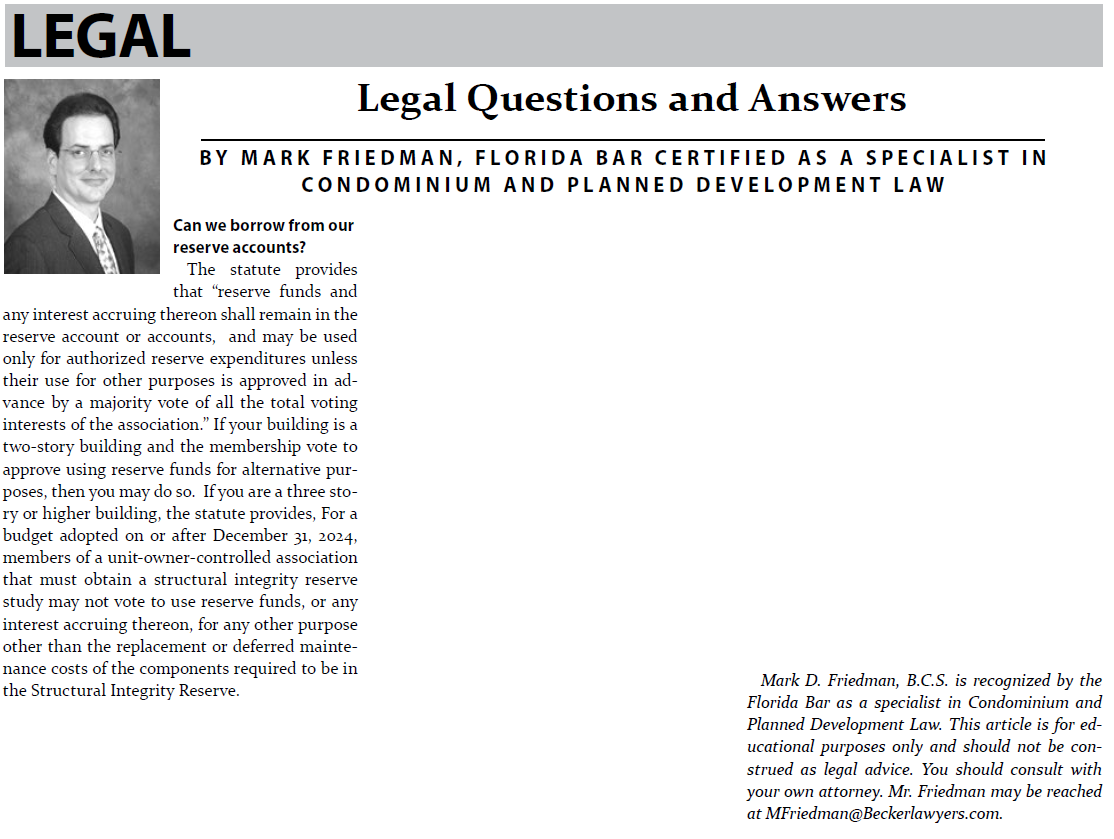
3. Reserve funds and any interest accruing thereon shall remain in the reserve account or accounts, and may be used only for authorized reserve expenditures unless their use for other purposes is approved in advance by a majority vote of all the total voting interests of the association. Before turnover of control of an association by a developer to unit owners other than the developer pursuant to §718.301, the developer-controlled association may not vote to use reserves for purposes other than those for which they were intended. For a budget adopted on or after December 31, 2024, members of a unit-owner-controlled association that must obtain a structural integrity reserve study may not vote to use reserve funds, or any interest accruing thereon, for any other purpose other than the replacement or deferred maintenance costs of the components listed in paragraph (g).